Case Study
Details
Product:
Wooden Bridge
Role:
Product Designer (User experience advocate)
Team:
Care transition research and clinical stakeholders, plus patient and caregiver partners (co-design)
Stack:
Figma, FigJam, Miro, Storybook, Userlytics, UserTesting, Jira, Confluence, Slack
Brief:
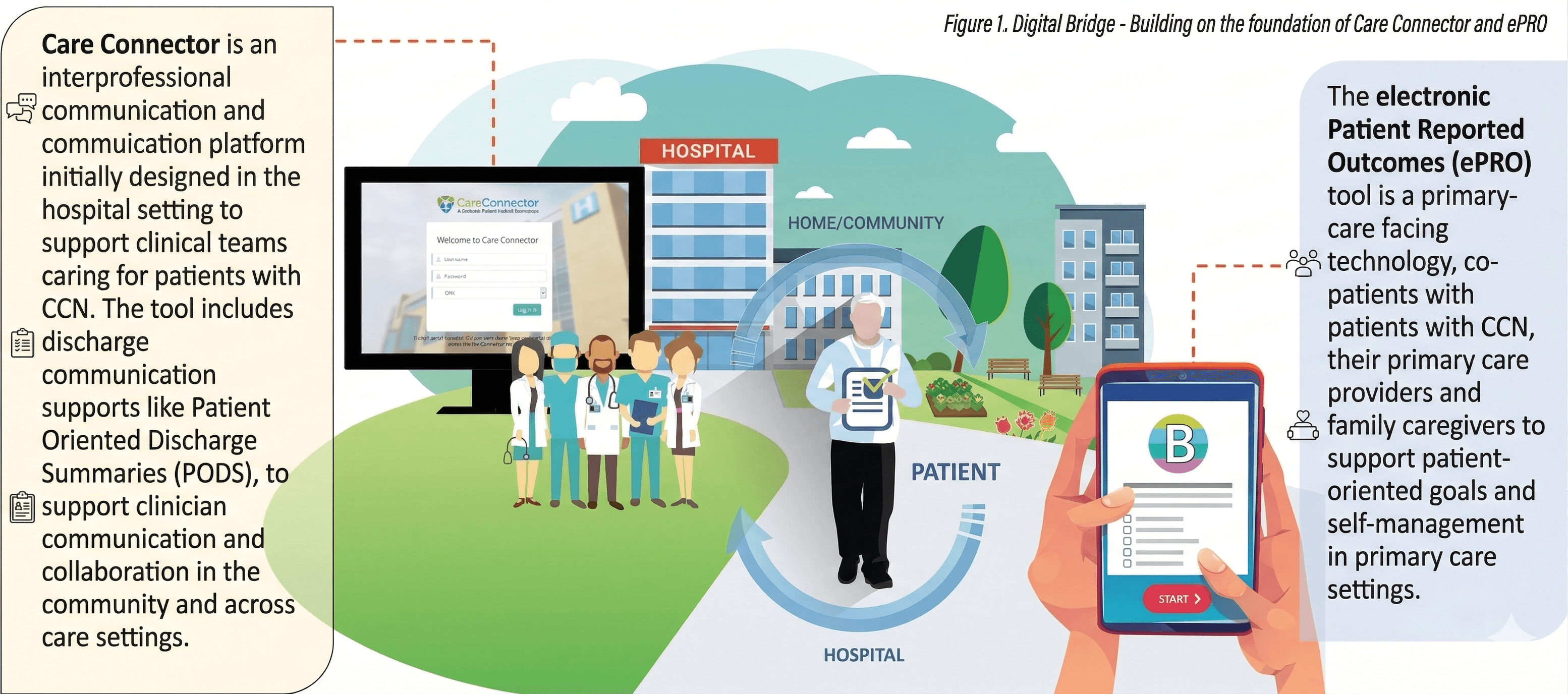
Wooden Bridge was developed within Digital Bridge to Home, a research initiative focused on improving hospital-to-home transitions using digital tools to support communication and continuity across patients, caregivers, and care teams. The broader programme set out to connect two tested platforms, Care Connector and ePRO, reinforcing an integration-first approach rather than adding another standalone tool.
Overview
A patient-owned transition hub that reduces confusion and coordination burden during hospital-to-home recovery.
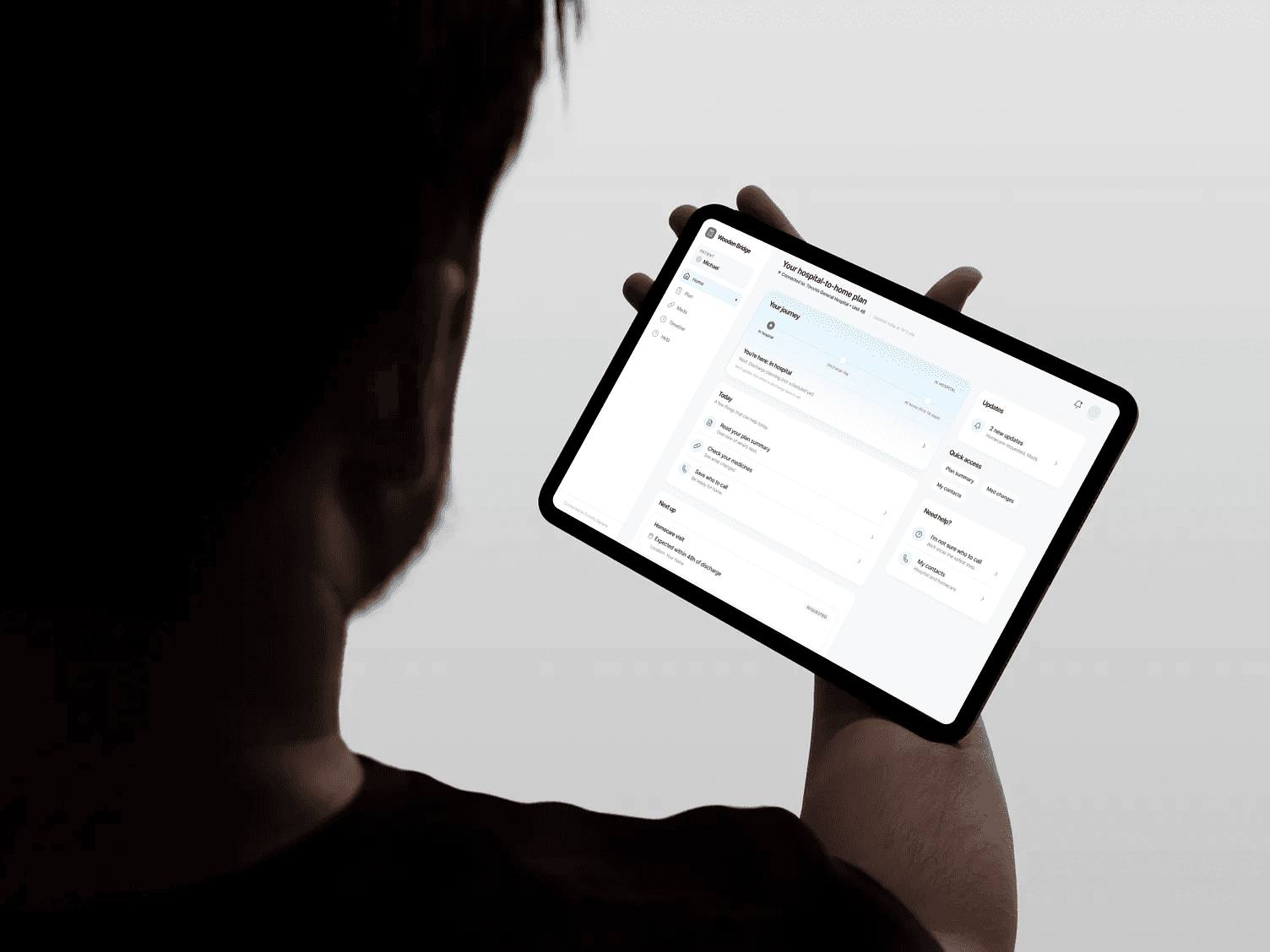
Wooden Bridge is a patient-owned, caregiver-permissioned digital platform designed to support the hospital-to-home transition. It helps patients and caregivers understand what changed during care, what happens next after discharge, and who to contact when questions or symptoms come up.
This work was developed within Digital Bridge to Home, a research programme focused on improving care transitions by strengthening communication and continuity across patients, caregivers, and care teams. Digital Bridge’s research direction was integration-first. It set out to connect two tested tools, Care Connector and ePRO, rather than adding another disconnected layer.
Wooden Bridge took that integration intent and translated it into a single, cohesive system designed around the patient and caregiver experience. Instead of exposing two separate platforms, we redesigned the experience as one end-to-end flow with a shared plan model, consistent status language, and a clear escalation path. The version documented in this case study reflects an MVP direction, developed to support research evaluation and patient testing, while also creating enough clarity and coherence to earn buy-in for a fuller system over time.
Context
Care transitions break down when responsibility moves faster than information and support.
Hospital-to-home transitions are a high-risk window for patients and caregivers, especially older adults living with complex care needs. Leaving hospital often shifts responsibility onto patients and families while recovery is still underway. Plans, medication changes, follow-ups, and community services are spread across people, tools, and timelines.
The research behind this project describes these transitions as requiring extensive coordination across settings, with common failures in communication, care coordination, and medication safety.  When continuity breaks, patients and caregivers carry the cognitive and logistical work needed to keep care moving, and that workload can increase after discharge.
Context; Why integration mattered
Digital Bridge to Home frames the transition period as critical and focuses on improving communication and continuity using digital tools that connect patients, caregivers, and care teams. The programme also set an integration-first direction by connecting two tested tools, Care Connector and ePRO, rather than adding another disconnected layer.
That context shaped the Wooden Bridge problem frame. The core issue was not a lack of information. It was fragmented responsibility. The design opportunity was to reduce the coordination burden by making the transition legible over time, including what changed, what is confirmed versus pending, and where to go when uncertainty arises.
Research and co-design; Research foundation
We grounded the work in lived transition experiences, then used co-design to turn patterns into an experience model.
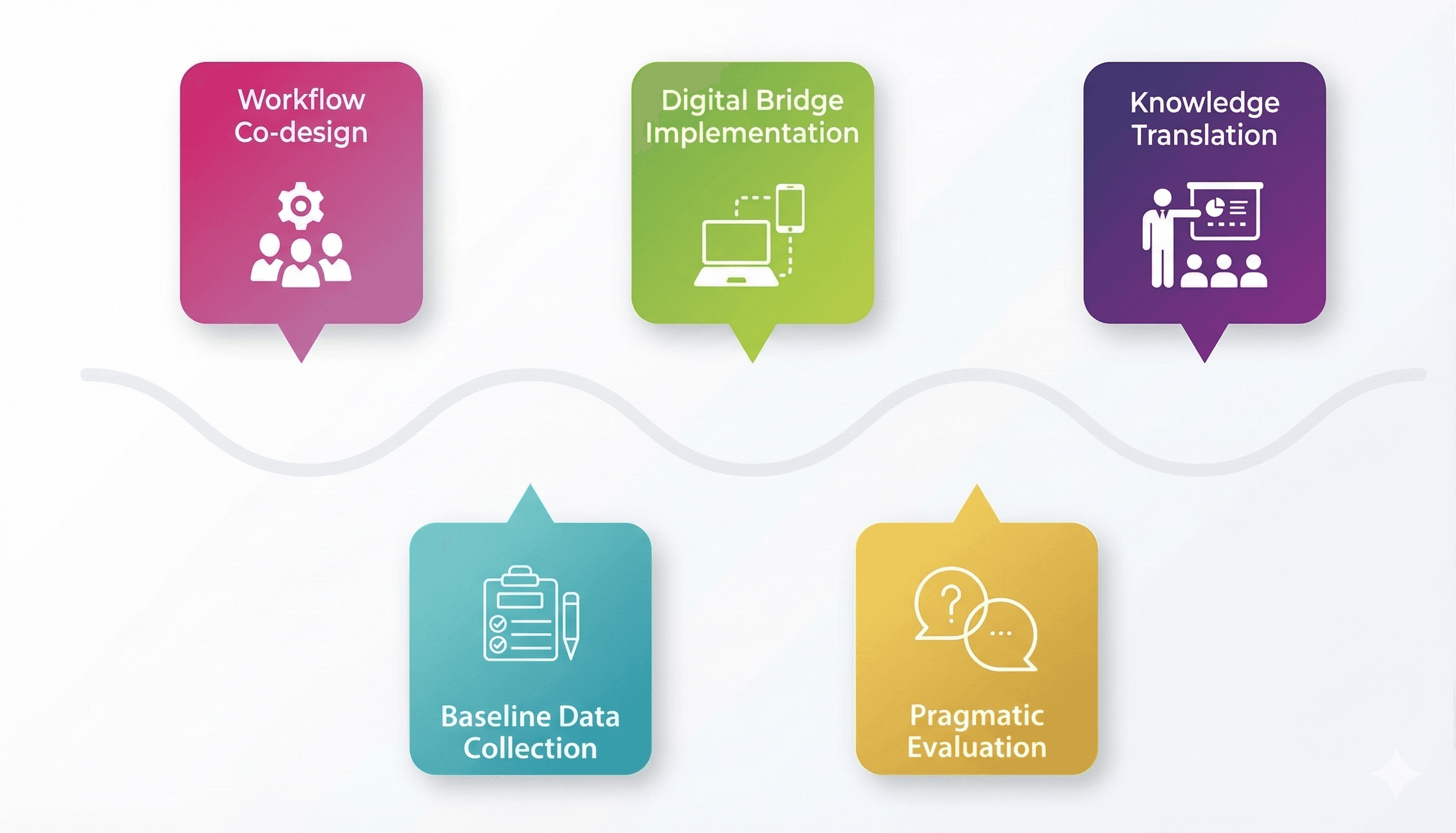
Wooden Bridge was developed within a research programme, so the design work started with evidence rather than screens. I contributed to the research that produced the study that was made published including planning and running co-design sessions as part of the broader team.
The study used qualitative interviews with older adults (60+) with complex care needs and caregivers who had experienced hospital-to-home transitions in Ontario. Participants were recruited through patient advisory groups at two hospital networks in Southern Ontario. The analysis combined inductive coding with a continuity-of-care lens, using informational, management, and relational continuity to interpret how transition breakdowns shape patient and caregiver work.
Research and co-design; Co-design and synthesis outputs
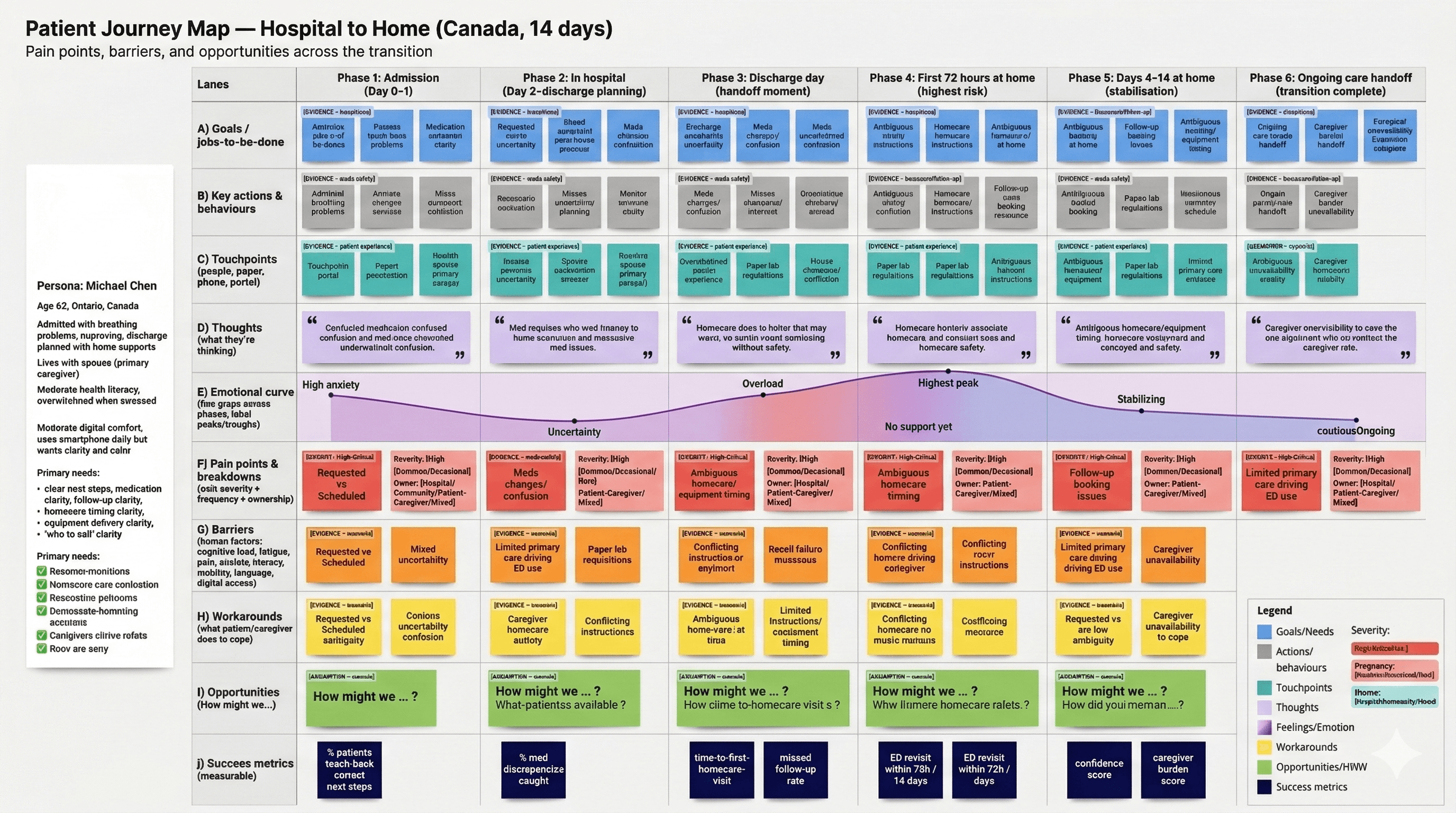
The interview findings were translated into nine recurring transition challenges, then represented in a vignette video to support discussion and engagement in later co-design workshops. Co-design helped us pressure-test early assumptions about where confusion truly comes from and what information becomes actionable at home.
From that work, we produced two synthesis artefacts that shaped the product direction:
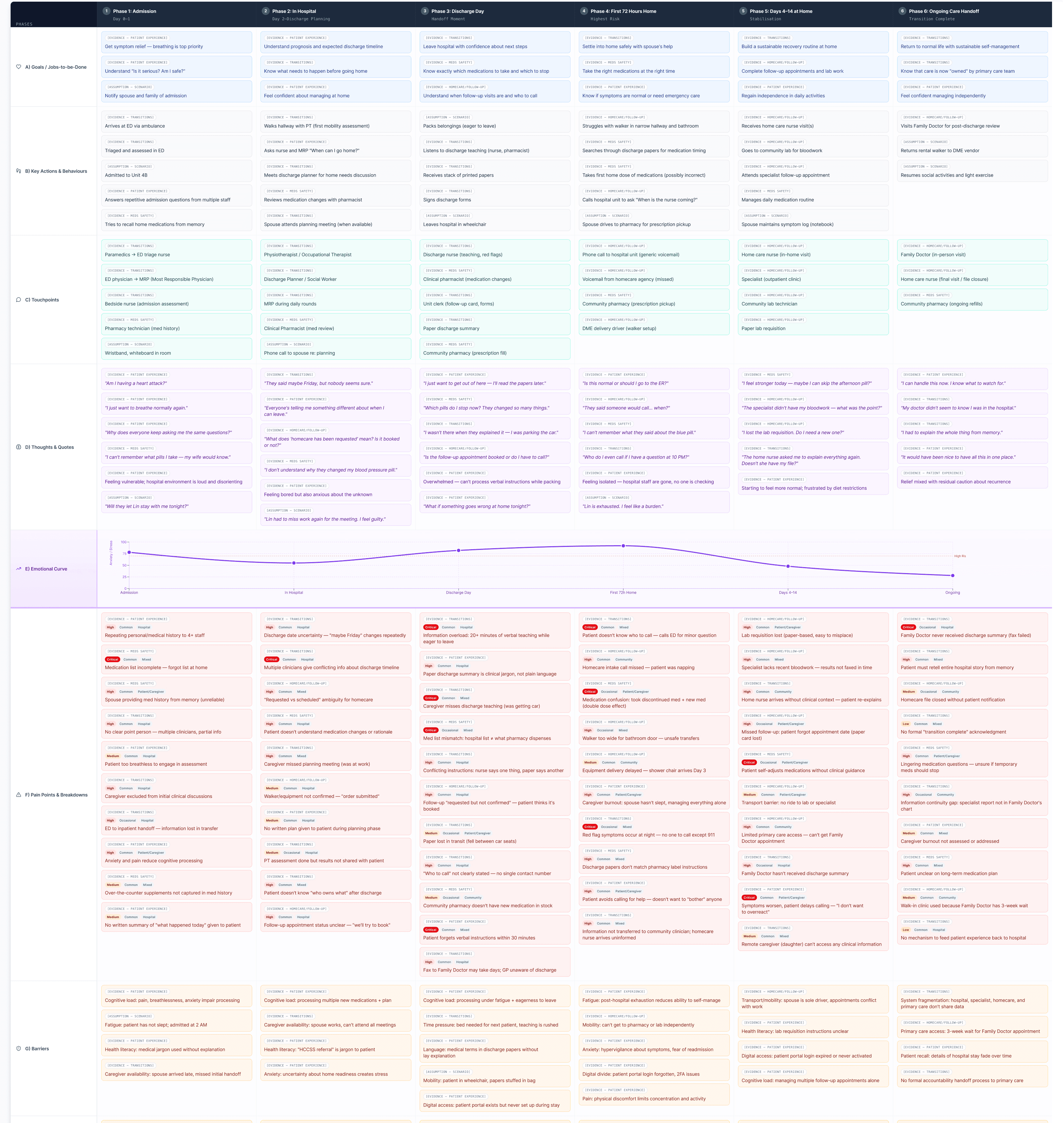
Patient journey map to make the workload visible across admission, discharge day, and the first days at home.
Service blueprint to clarify frontstage and backstage dependencies, including where “status” and “ownership” break down across hospital and community care.
These artefacts became the bridge into product decisions. They clarified where the experience needed to provide orientation, where it needed to surface change, and where it needed to offer a safe escalation path without asking patients and caregivers to coordinate the system themselves.
Reframing the problem
The research and co-design work surfaced a consistent pattern. Patients and caregivers were not struggling with a single missing artefact. They were trying to keep a transition plan coherent while it changed over time. Medication regimens shifted. Follow-ups were sometimes pending. Community services depended on multiple teams. When status and ownership were unclear, people filled the gaps through calls, repetition, and escalation.
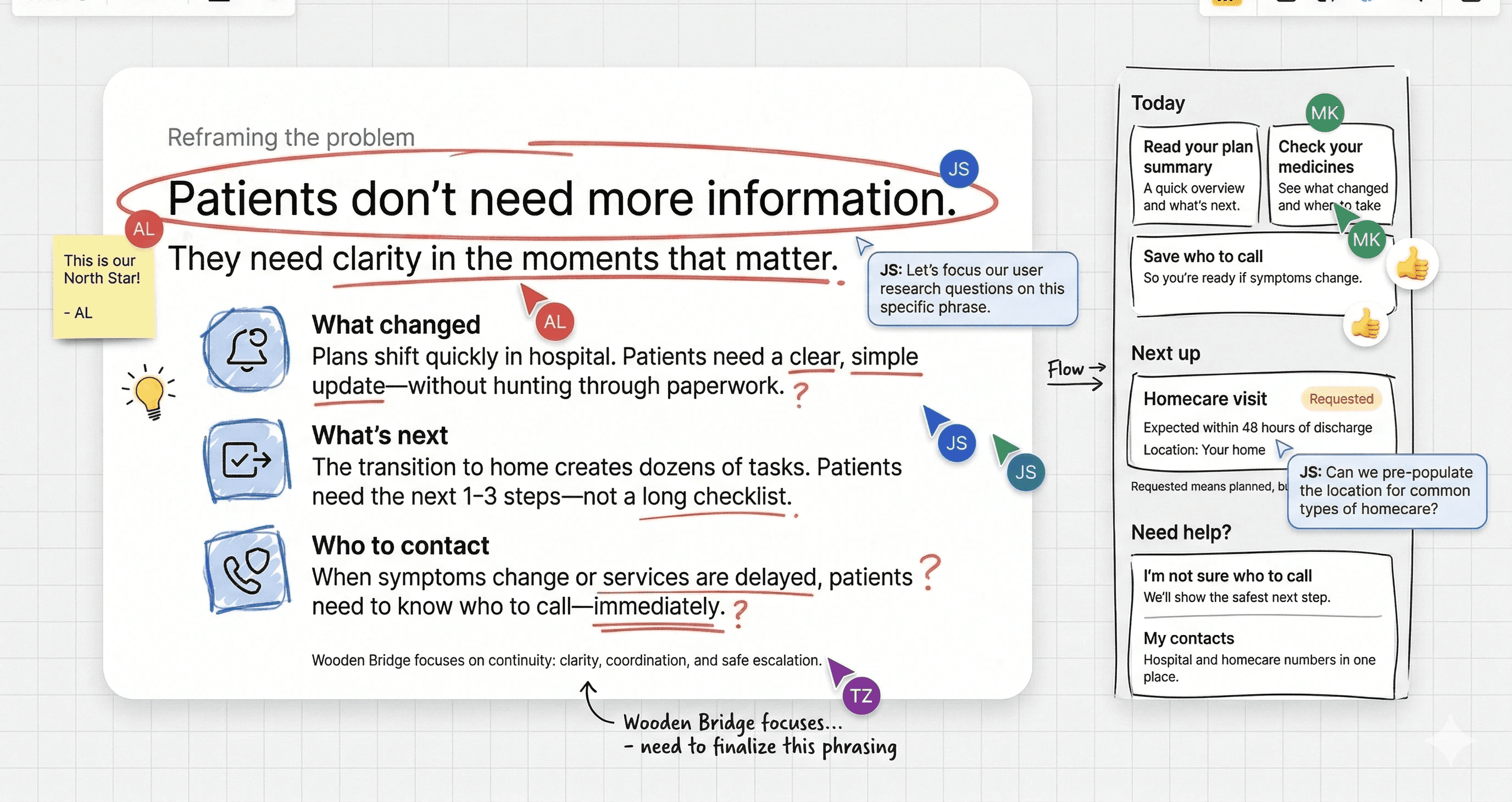
That insight changed how we defined the design problem. The team needed a patient-facing system that could hold the plan together across the full transition, starting earlier than discharge and staying useful through the first days at home. The goal became reducing coordination burden by making three things consistently legible:
What changed, including medication updates and plan adjustments
What happens next, including what is confirmed versus still being arranged
Who to contact, using a safe escalation ladder that supports decision-making without attempting diagnosis
This reframing set the foundation for Wooden Bridge’s experience model and information architecture. It also established a key boundary condition. The interface had to remain usable even when data was incomplete or delayed, because that is the reality of care transitions.

Key insights
Patients needed orientation before action
During transitions, people were trying to answer basic questions quickly: where they are in the journey, what happened in hospital, and what matters next. Without that orientation, even accurate information felt hard to use. The study frames this as cognitive work that increases after discharge, including reviewing information, making decisions, and coordinating tasks.
Status uncertainty created more work than lack of detail
A major source of friction was unclear progress across services. Patients and caregivers often needed to understand what was booked versus still in motion, and who was responsible for moving it forward. The continuity lens in the research reinforced how breakdowns in management continuity and information transfer increase workload.
Escalation was a routing problem
After discharge, symptom management becomes part of the transition workload. When people are unsure what is normal, they need a safe next step that reduces hesitation and prevents avoidable escalation.
These insights shaped a set of clear experience requirements:
The platform needed to anchor the patient in the journey and make the plan understandable at a glance.
Status and ownership needed a strict vocabulary that stays consistent across the interface.
Change needed to be easy to find and easy to interpret, without searching through multiple sections.
Help needed to provide a safe escalation ladder, plus contacts that match urgency.
The experience needed to stay useful when information was incomplete, so patients could still act on what is known.
Design principles
Orientation is part of the interface
Every screen should answer where the patient is in the transition and what this information relates to.
One stable vocabulary
Statuses, updates, and ownership language must stay consistent across the system so users can build a reliable mental model.
Change needs a home
Updates should be visible, timestamped, and traceable back to the specific plan, medication, or timeline item they affect.
Actionable, not exhaustive
Prioritise the next best action over completeness. Provide a clear path to detail when needed.
Safety over cleverness
Help supports escalation and contact decisions. It stays away from diagnosis and stays implementable within healthcare governance.
Design for partial information
The system should still work when details are missing or delayed, using clear states and next steps instead of blank screens.
System model
Mapping the service around the interface
During transitions, people were trying to answer basic questions quickly: where they are in the journey, what happened in hospital, and what matters next. Without that orientation, even accurate information felt hard to use. The study frames this as cognitive work that increases after discharge, including reviewing information, making decisions, and coordinating tasks.
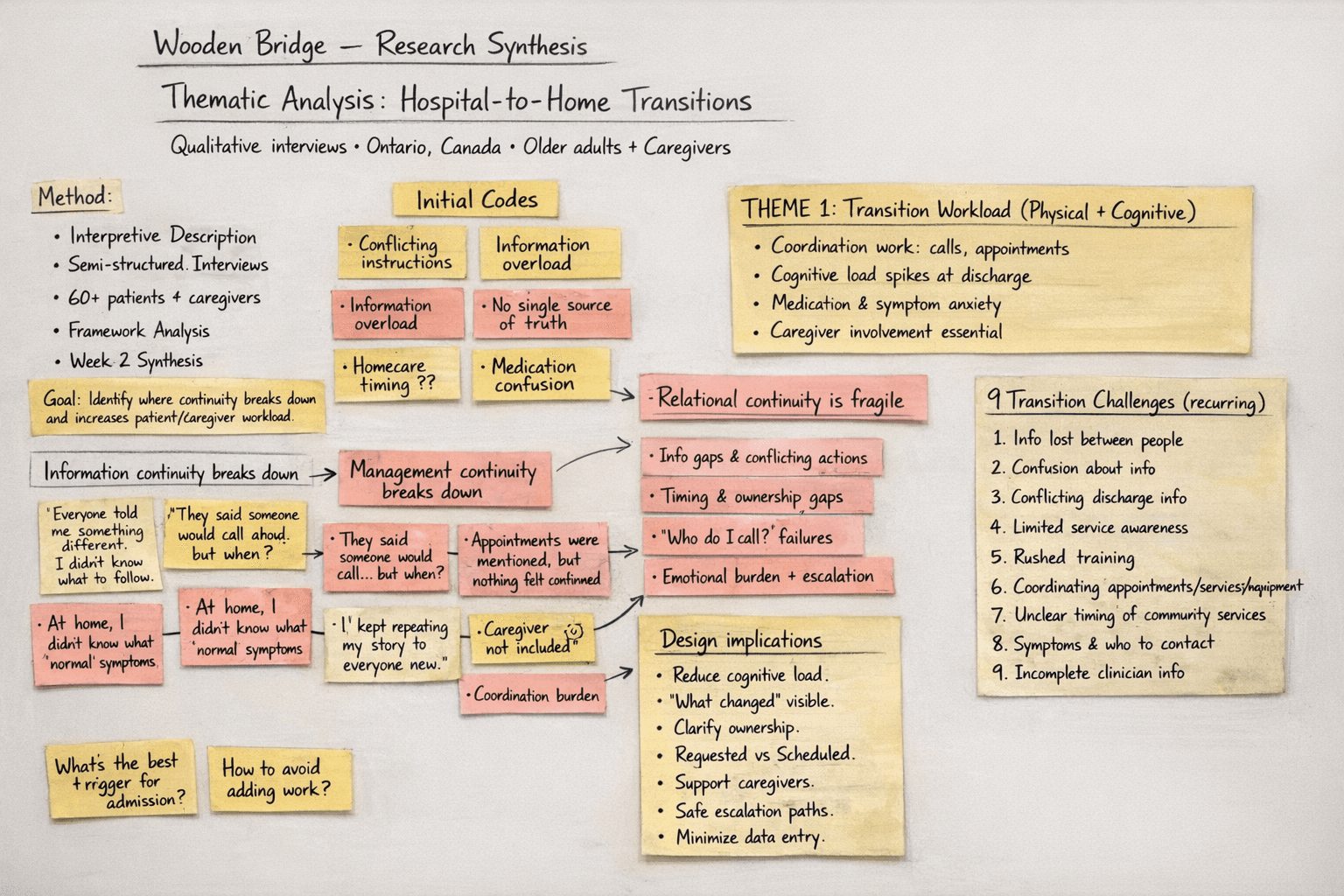
We used two artefacts to hold that complexity:
Service blueprint to separate what patients and caregivers experience from the backstage work required to deliver care.
Journey map to show where cognitive load spikes and what work patients and caregivers take on to keep care moving. This approach aligns with the continuity framing used in the research, which describes transition workload as physical and cognitive effort shaped by informational, management, and relational continuity.
This approach aligns with the continuity framing used in the research, which describes transition workload as physical and cognitive effort shaped by informational, management, and relational continuity
Wooden Bridge sits downstream of hospital and community systems. We assumed the hospital could provide key transition inputs, mostly read-only:
discharge summary and instructions
medication list and documented changes
referrals and orders (homecare, equipment)
appointments, tests, and follow-ups
care team contacts and escalation pathways
We also designed for the reality that these inputs arrive unevenly. Some services are pending. Some details are missing. Some plans change after discharge. The interface needed to stay useful anyway, using clear states and next steps rather than relying on a perfect feed from every system.
The results experience was redesigned as a system rather than separate pages. Health Insights became the default view to summarize priorities and provide context. Indicators remained available for transparency, but were redesigned to be more consistent with Insights and easier to read. To support follow-through, we introduced Habits as a lightweight plan tied to results—so users could move from “what does this mean?” to a practical next step without feeling alarmed or overwhelmed.
That boundary was deliberate. The product was not trying to replace clinical systems or coordinate care on behalf of providers. It was designed to make the patient-facing plan legible, reduce coordination burden, and support safe escalation when uncertainty shows up.
Product direction
The system model clarified a core requirement. Patients and caregivers needed a single place that could hold the transition plan together as it changed, without exposing the complexity of multiple underlying tools.
We shaped Wooden Bridge around five recurring questions patients asked during the transition:
Where am I in the journey right now?
What needs attention today?
What changed since the last update?
What is confirmed, and what is still in progress?
Who do I contact, and what do I do next, when something feels off?
This led to a focused experience model: a patient-owned plan with permissioned caregiver access, designed to stay calm and predictable under stress. It also informed the decision to start the experience at admission, giving patients time to build familiarity with the plan before discharge day.
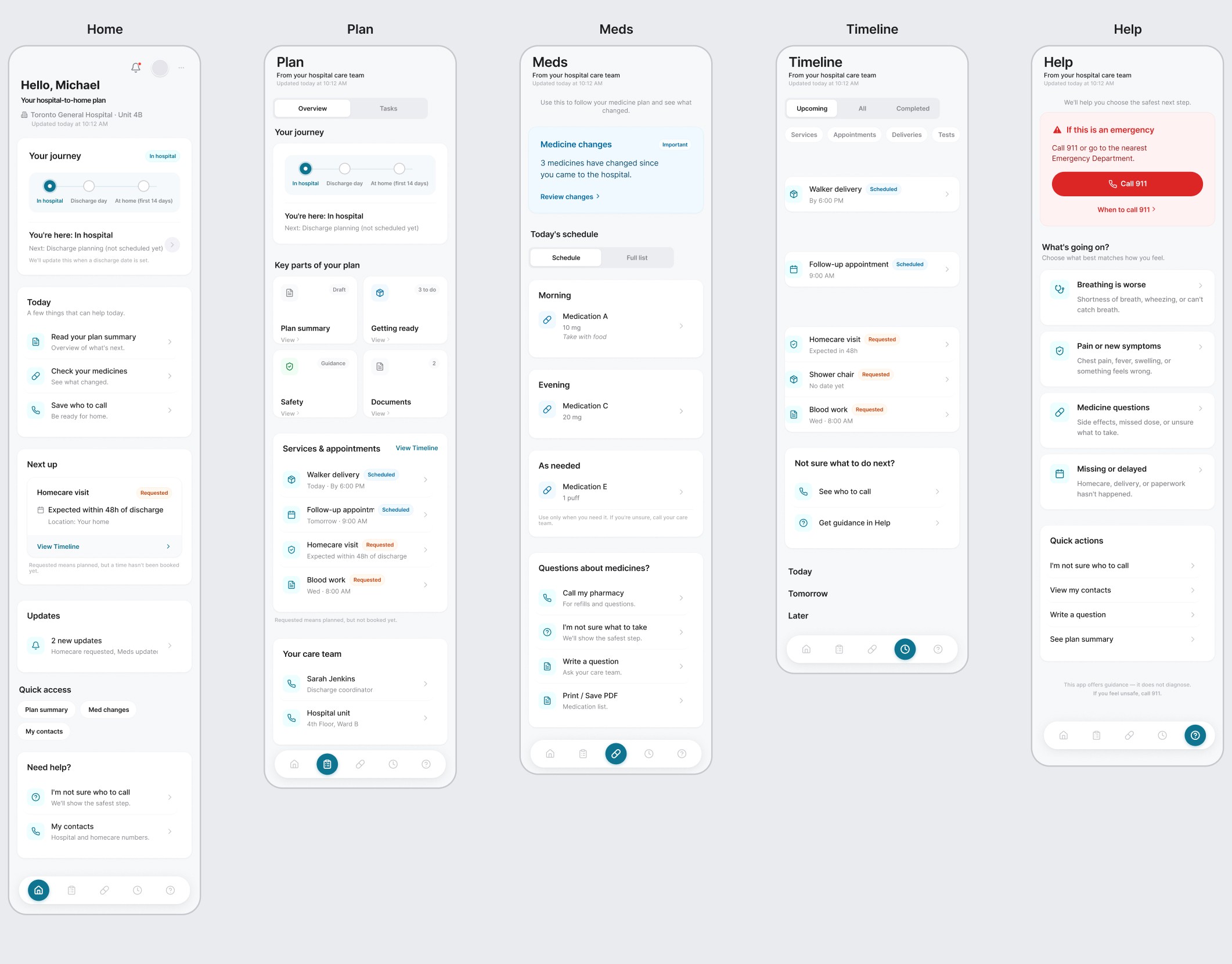
At an information architecture level, the product was intentionally constrained to five primary destinations:
Home anchors orientation and daily priorities. •
Plan provides a curated briefing of what happened and what comes next.
Meds isolates medication schedules and changes to reduce error risk.
Timeline externalises coordination and status across tasks and services.
Help provides an escalation ladder and contacts matched to urgency.
Everything else was treated as a subpage with predictable back behaviour. This kept the system learnable and reduced portal sprawl.
Key design decisions
Start the experience at admission Patients needed time to build familiarity with the plan before discharge day. This reduced last-minute overload and created a stable frame for updates.
Patient-owned, caregiver-permissioned access This respected autonomy while supporting shared coordination. It also matched real caregiver involvement, which varies by person and over time.
Five primary tabs, strict navigation rules Home, Plan, Meds, Timeline, Help. Everything else lives as a subpage with consistent back behaviour. This kept the system predictable and avoided portal sprawl
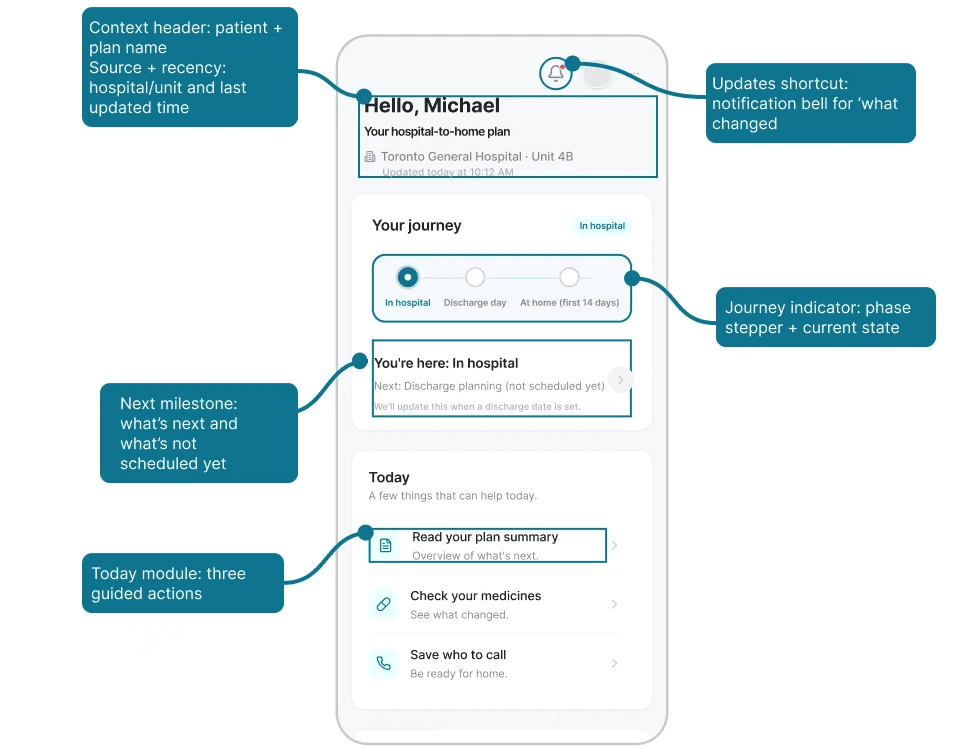
Home as the anchor, with “Today” as a module The app needed to feel like an ongoing plan, not a task list that appears after discharge. Home provides context first, then priorities.
Status pills with a strict vocabulary
We limited status language to Requested, Scheduled, Completed to support a stable mental model across the experience.
Microcopy patterns that repeat on purpose
Patients under stress benefit from consistency. We standardised phrases such as source attribution, update timestamps, and short definitions where needed.
Updates feed with deep links
Changes happen frequently. A single entry point to updates reduced searching and made “what changed” easy to verify.
Master-detail pattern for timeline items
“Next up” needed a place to land that explains status, ownership, and the next step in context.
Help as an escalation ladder
The goal was safe routing and implementable guidance. The experience supports contact decisions without diagnosing.
Final experience MVP
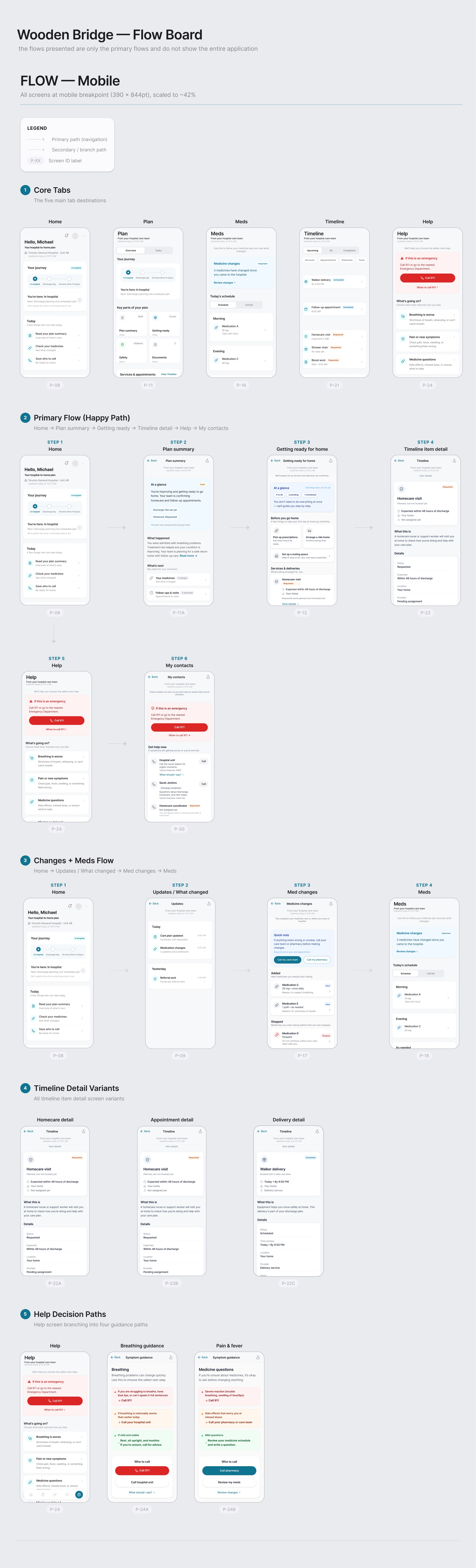
Orientation and daily focus
Home anchors the experience with context, where the patient is in the transition, and a small set of priorities for the day. This reduces scanning and prevents the plan from feeling like a list of disconnected tasks. The “Today” module surfaces the next best actions, while “Next up” previews upcoming items without forcing users into the Timeline.
Understanding the plan and what changed
Plan acts as a curated briefing. It provides a stable place to review what happened during the hospital stay, what is expected next, and what needs preparation for discharge and home recovery. Changes route through the same structure. Updates link back to the relevant plan, medication, or timeline item so users can understand impact quickly.
Coordination, medication safety, and escalation
Timeline externalises coordination across appointments, referrals, and services. Each item expands into detail that clarifies status, ownership, and next steps. Meds isolates medication schedules and highlights changes in a consistent pattern to reduce confusion during recovery. Help provides an escalation ladder and contacts matched to urgency, supporting safe next steps when symptoms or uncertainty show up.
Outcomes
This project was primarily a research and framing effort. The main outcome was a clear definition of the problem space and a patient-facing MVP that could be evaluated without introducing additional coordination work for clinicians.
The product work translated research and co-design input into a coherent experience model: a shared transition plan with consistent language, explicit status, and a safe escalation path. In parallel, the journey map and service blueprint clarified where continuity breaks across admission, discharge, and early recovery at home. Those artefacts helped align clinical and research stakeholders on what the MVP could support in an early version, and what needed to remain out of scope to avoid shifting burden onto healthcare workers.
A deliberate boundary guided the work. Wooden Bridge was designed as a coordination layer for patients and caregivers, while assuming existing clinical workflows and systems would remain the source of truth.
Reflection
The core challenge was not screen design. It was shaping an experience that reduces patient workload without creating new surfaces clinicians need to maintain, explain, or troubleshoot. I stayed grounded by treating research as the primary design input and by mapping the service system before committing to interface structure.
Three practices guided my approach:
Start with the service, not the UI
Mapping the transition revealed where responsibility shifts and where ambiguity accumulates.
Design for uncertainty as a first-class constraint
The experience needed to remain useful when services were pending, timelines shifted, or information arrived late.
Prefer stable rules over clever solutions A strict status vocabulary, predictable navigation, and repeated microcopy patterns were more valuable than additional features.
If I were revisiting this project, I would adjust three things:
Operationalise ownership earlier
Status language helps, but responsibility often stays implicit. I would test clearer ownership cues that remain accurate without overpromising.
Validate comprehension sooner with lower-fidelity prototypes
I would test the mental model earlier, especially around status interpretation and escalation decisions, before refining interaction patterns.
Stress-test the design against real integration gaps
I would design and test “missing data” states earlier using realistic scenarios, since that is where trust tends to break.
This project reinforced a core belief in patient-facing healthcare design: clarity comes from deliberate constraints. The product succeeds when it keeps the plan coherent as it changes, reduces coordination burden, and supports safe next steps, while respecting the operational realities of care teams.
Related work